
What Is Colour Management? A Complete Guide for Printing and Packaging
Colour management is the difference between a brand colour that holds across every press, every substrate and every shift, and one that drifts until the customer rejects the job. It is the discipline that turns colour from an argument into a measurement.
Most colour complaints on a shop floor are not caused by careless operators. They are caused by the absence of an agreed target, a way to measure it, and a process for bringing the press back when it moves. This guide explains how colour management works in practice, what G7 adds to it, and where to start if your colour is currently controlled by eye.

Key Advantages of Colour Management
colour is agreed by measurement before the run, so fewer jobs are returned after delivery.
an operator matching to a known curve reaches the target faster than one chasing a visual match.
shorter approach to colour means less substrate and ink consumed before the first good copy.
a measured target lets you reproduce a job months later without the original samples.
Delta E values replace arguments about whether a job is acceptable.
What Is Colour Management?
Colour management is a controlled workflow that keeps colour predictable from the design file through proofing, platemaking and printing, on every device that touches the job. It replaces subjective judgement with numbers that everyone in the chain can check.
The workflow rests on three parts. A defined target says what the colour should be. Measurement says what the colour actually is. A correction loop closes the gap between them, on the press rather than in the artwork.
Without those three parts you do not have colour management. You have colour opinion, which changes with the operator, the light in the inspection area and the time of day.
How Colour Management Works
Colour management works the same way on an offset press in Dubai and a gravure press in India, because it depends on measurement rather than on any particular machine.
Measuring Instead of Judging
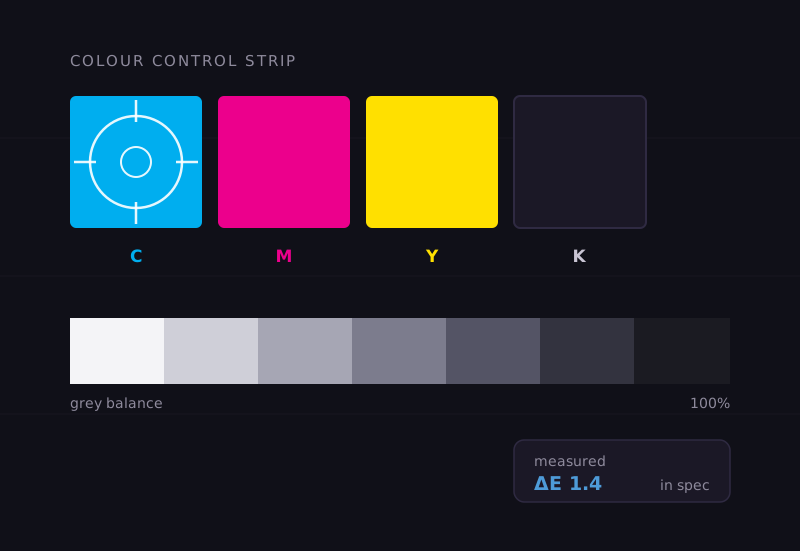
The human eye is excellent at comparing two samples side by side and unreliable at remembering a colour from yesterday. A spectrophotometer removes that weakness by describing colour as numbers, usually in the CIELAB space, so a sample can be compared against a target months later.
The difference between the target and the print is reported as Delta E. A small Delta E means the colours are close, and most packaging specifications set a tolerance that production has to stay inside. Measurement also needs conditions everyone agrees on, which is why measurement modes such as M1 matter when substrates contain optical brightening agents.
Profiles, Standards and G7
An ICC profile describes how one device reproduces colour, so an image can be converted sensibly between a monitor, a proofer and a press. Profiles alone are not enough, because a profile assumes the press behaves the way it did when the profile was made.
That is where print standards come in. ISO 12647 defines the target values for the process, and G7 defines how the greys in that process should behave, using grey balance and a neutral tone curve. A press calibrated to G7 produces the same visual appearance of greys and highlights as any other G7 calibrated press, which is why a job can move between sites and still look right. As a certified G7 Expert I use fingerprinting to characterise the press first, then calibration to bring it onto the curve, then verification to prove it stayed there.
Common Applications of Colour Management
Get Expert Printing and Packaging Solutions
If colour is costing you rejections, waste or makeready time, I can help. I am a certified G7 Expert based in the UAE, and I work with printers and converters worldwide, on site and remotely, across gravure, flexo, offset and digital production. Typical work includes press fingerprinting and calibration, building a measurement routine your operators can actually run every shift, setting realistic tolerances with your customers, and training your team so the process survives without me. Send me your problem and I will tell you where to start.
Conclusion
Colour management is not a purchase, it is a process. The instrument matters far less than having an agreed target, a routine for measuring it and the discipline to correct the press when it drifts. Standards such as ISO 12647 and methods such as G7 exist so that target can be shared across sites, suppliers and countries rather than living in one operator's memory. Start by characterising what your press does today, and you will be surprised how much of your waste was avoidable.
Colour Management vs. Correcting Colour on Press
measurement gives a target that does not change with the operator, the viewing booth or the time of day, and it can be verified by the customer.
calibration fixes the cause rather than the symptom, so the same file prints correctly on every subsequent run instead of needing rework each time.
a fingerprint of your own press describes how your machine, inks and substrates actually behave, which generic profiles cannot do.
For most packaging printers the practical answer is a calibrated process plus measurement at the press, rather than skilled correction after the problem appears.
Questions people ask
At minimum a spectrophotometer and a colour bar on every job. Software for profiling and reporting helps, but the discipline of measuring every run and recording the numbers delivers most of the early gains.
It depends on the customer and the process, and it should be agreed in writing before production. Brand colours are usually held tighter than image areas, and the tolerance must be achievable on the substrate in question, which is why fingerprinting comes before tolerance setting.
No. ISO 12647 sets target values for the printing process, while G7 defines how greys and tone should appear so that different processes share a common visual appearance. They are complementary, and many printers work to both.
Yes, and that is usually the point. Each process is calibrated to the same appearance target, so the same brand colour can be produced on different machines and still match within tolerance.
Fingerprinting and calibration on a single press is typically a short on site exercise, but the lasting benefit comes from the routine that follows. Verification, operator training and a simple record of measurements are what keep the press on target months later.
Keep reading
Questions about this guide?
Send me your question on WhatsApp and I will get back to you personally.